
Lazy Days of Summer Require A Different #SocialMediaMarketing Strategy? http://ow.ly/NBiyw #SMM #Marketing http://ow.ly/i/b2Xsq
“We must move past campaign thinking”
“We must move past campaign thinking” via @Robert_Rose @CarlaJohnson on @smexaminer http://ow.ly/N0LnH #Marketing #Advertising #PR
My new article on @smexaminer “How to C
My new article on @smexaminer “How to Create a #SocialMediaMarketing Plan” http://ow.ly/MWkc0 #SMM #Marketing http://ow.ly/i/aOqwx
Upcycling Content: Four Ideas To Repurpose Existing Resources For Social Media Updates.
Upcycling isn’t just for crafts or Pinterest. It is simply a concept where old products are given more value. Upcycling in social media it is a way to optimize your time and effort.
Embed from Getty Images
Startup R3DNA recovers leather from salvaged luxury cars to be repurposed into bags, iPad covers and leather jackets.
Here are four ways you can reuse and repurpose for social media content:
1. Underutilized parts of your website. Are there valuable parts of your website that if you are honest with yourself no one really uses? Today people want content brought to them.
I used to work for a bank that had an excellent small business toolkit. It was valuable information from finance and HR to marketing tips. The problem was no one used it because they didn’t know it was there. How often do you surf your bank or other banks websites?
Our idea was to divide the long form website content into short chunks and push it out as small business tips on social media. Upcycling already created content to social can build awareness and drive traffic to the website, but it also helps build relationships in social media.
What valuable information is on your website or hidden in a brochure sitting on a shelf that you could repackage as valuable social media content?
2. Play By Play Of Live Events. Public Relations professionals have used events as a powerful publicity tool since the last century. Today you can multiply that power by bringing the event to many more than can attend in person.
For a regional airport client we planned a live contest where two local radio DJ’s flew to Chicago and back in one day. One took a flight from our local airport and the other took a flight from the farther big city airport. We demonstrated that you could save money, distance and time flying from our client’s airport when most people thought it was too expensive.
The airport received enormous buzz online as we updated Facebook, Twitter and UStream videos of each DJs progress. The event would have been successful with just the live reports on the radio, but Upcycling the live traditional media content to social media upped the awareness.
Do you have a live event coming up where you could up the exposure by reporting it on social media channels?
3. B-Roll Video And Photos. Producing a TV Commercial can take up to month and cost a lot of money. The average 30 second spot cost $350K. During a day long shoot you collect a lot of footage that doesn’t make the 30 second final cut.
Why not leverage extra footage as social content? A director’s cut, alternative version, or “making of” video can really draw fans. We all love to get a look behind the scenes. You could also share still photos online during the shoot via Instagram, Pinterst or another photo site for a sneak peak.
Either way you get more for your investment by upcycling video and photo content being produced for other uses. For more engagement you could even post different versions of the TV ad and have your fans vote on the final cut.
Do you have a TV or video shoot coming up that you can leverage as social media content? What about a still photo shoot?
4. Front Line Employees. Remember the small business tips for the bank example above? Our second idea was to empower branch managers to send out the small business tips via their LinkedIn, Twitter and Facebook accounts as a way to generate leads for new accounts.
These managers were tasked with signing up new business accounts anyway. Why not give them another tool besides cold calls and post cards?
Unfortunately their response was that they blocked access to social media in the offices for employees. Some upcycling requires an open mind and may require some new guidelines such as an employee social media policy.
Is there a way you can upcycle your employees? Best Buy leverages their blue shirt in-store associates’ knowledge and down time to answer people’s tech questions on Twitter building awareness and goodwill for the brand.
Can you think of other ways to upcycle existing efforts into fresh social media content?
Big Data Can’t Create. 5 Step Creative Formula For Big Ideas in Social Media.
Everyone seems to be talking about big data. And for good reason. Knowing which content is driving more conversion is important, but analytics can’t write and there’s still no app for a big idea.
A simple Google search on the term “Big Data” reveals 2 billion results while a Google search for “Creativity” only brings back 60 million results. Nearly 50% more attention is being devoted to data, but I say half of social success depends on creativity built on top of and verified by good data. Not a direct measure but research has proven that 65% of TV ROI is attributable to the creative and 35% to the media data.
Big ideas drive social action.
Knowing humor is a common characteristic of viral videos doesn’t create the video. A list of high performing key words doesn’t simply form into a good piece of content. Both need a creator.
Yet, you don’t need to be Picasso or da Vinci to be creative. Knowing the creative formula can help you be more creative. I was surprised that there is a formula or process to creativity until I read A Technique for Producing Ideas. by James Young Webb with a forward by Bill Bernbach. Then I discovered that as an advertising creative I followed this technique naturally.
Production of ideas follows a definite and necessary process. The formula is so simple that few believe it. As Young Webb said, “While simple to state, it actually requires the hardest kind of intellectual work to follow, so that not all who accept it use it.”
What is the creative formula?
Step 1: Gather Raw Materials – Both the materials of your immediate problem and the materials of your general knowledge. Gather research on your company, competitors, target audience, but also general knowledge about life and current trends.
Step 2: Mental Digestion – The working over of these materials in your mind. Try all these pieces of information together this way and that. Bring two facts together and see how they fit – look for a relationship.
Step 3: Incubation – Here you let something beside the conscious mind do the work of synthesis. Make no effort of a direct nature. Drop the whole subject, and put the problem out of your mind. Go see a movie, play basketball, work on another project.
Step 4: Eureka Effect – The actual birth of the Idea – the “Eureka! I have it” stage. This tends to come when you least expect it. In the shower, in the middle of the night, on a run. Always be prepared to write it down. Big ideas are fleeting and can leave just as quickly as they came.
Step 5: Final Finessing – The final shaping and development of this idea to practical usefulness. Take your idea out into the world of reality. Here you may need to adjust it and make it fit the company, product, target, social channel, etc.
In my experience, the process would get short changed by deadlines, and expectations of those who believed writing is simply sitting down and typing. I never sat down to type until I first had an idea. When you have an idea the ad, plan, paper, story, book, almost writes itself. If you skip the incubation stage, you miss out on really brilliant big ideas.
Everyone has creativity, but sadly most of us left it behind with childhood …
Social Media: A Post-Control World
One of the main things I have learned working through the digital and now social media revolutions is that the truth, transparency and power of social media requires a fundamental shift in thinking for the marketing, advertising and PR profession.

If we truly want to control brand communication today, we must be willing to give up control. Not an easy thing for human nature and professional disciplines that are taught and practiced in the very opposite manner. Pick up any Principles of Marketing, Advertising or Public Relations text and you will find the same – methods, strategies, and processes all designed to control the message.
Even with the advancement of the new discipline of Integrated Marketing Communication (IMC) all brand communication is attempted to be controlled an put into one unifying message across consumer touchpoints to combat advertising clutter and loss of mass media audience.
Maybe that is why so many marketers continue to shift resources to social media, yet admit they don’t know how to integrate social into their traditional efforts. But the consumer revolution is happening and consumers now have the influence of mass audience. When word of mouth gets super charged with social media, perhaps traditional is no longer an appropriate base from which to start.
As Seth Godin says, “Your consumers are talking about you whether you like it or not.”
Perhaps we are all looking at this from the wrong perspective. We shouldn’t be figuring out how to compartmentalize social media as a nice little addition to our current marketing efforts. Social is much bigger than that. Instead we should begin with social media and figure out ways we can integrate the consumer’s voice across the discipline silos of advertising, PR, and Digital and across the business unit silos of marketing, operations, R&D, customer service, etc.
Whether we like it or not we now live in a Post-Control Marketing world, a post Four P’s (Product, Price, Place, Promotion) where our brands are no longer our own. Today we need to build brands around the consumer and the Four C’s of Consumer, Costs, Convenience, and Communication. This may seem like a small difference but as Carol Dweck has taught us, Mindset can make all the difference in the world.
A funny thing happens when you give up control, your product and service becomes better. Your customers help you create the products they want, the communications they’re interested in, freely share your brand messages and help you improve your service. Everyone gets more of what they want. The consumer is no longer a target to be conquered, but a business partner for mutual benefit. And in the end you meet and exceed the marketing and business objectives you wanted in the first place.
Are you ready for Post-Control Marketing? Do you know how to integrate social media for the consumer revolution?
100 Insights For New Media Marketing
For my 100th post on this blog, I thought I would share all 100 insights in one place. Each listing is a link back to the original post.

100 Insights For New Media Marketing:
1. Is New Media Killing Traditional Media’s Star?
2. Are Bloggers More Sensitive To Spin?
3. Technology Makes Us Dumber, Less Productive And Stressed Out
4. Which Advertising Medium Is best?
5. Can Direct Response Be Creative?
7. Why Does New Media Matter? Because United Breaks Guitars
8. The Last Thing We Need Is Another Blog
9. Walk A Mile In Zappos’ New Media Shoes
10. Tu Voz Rings True For Minority Marketing
11. More Information On Information Overload
12. Does Copy Matter Less On The Web?
13. Can The iPad Save My Newspaper?
14. Are You Ready For A Content Revolution?
16. Is There A Creative Process?
17. Is All Buzz Good And Cheap?
18. Brand Extensions Achieve MAXIMum Failure
19. Speak Softly And Carry A Big Marketing Stick
20. Is Facebook’s Privacy Policy Friend or Foe?
21. BP Can’t Get Beyond Petroleum
22. Are Mobile Ads Still Annoying?
23. Are Intellectual Property Rights Wrong?
24. EBSCO, Forbes, Time Open The Digital Divide
25. Yahoo Cheers Associated Content Acquisition–Society Jeers
26. Can Millennials Save Us Through Cause Marketing?
27. Creativity Beats Media In TV ROI
28. GM Recall Recalls Past PR Crises
29. Cause Marketing Or Crisis Response?
30. US Census: Bad Ads But Great Information
31. Where Is The Star Power In The Gulf Clean Up?
32. Cause Marketing’s Future Is Engagement Through Social Media
33. Churchill, TED And New Marketing
34. Blah, Blah, Blog: Why Companies Should Listen
35. Online Research: Temptations and Limitations
36. Does .005% Make A Difference? Ask Toyota
37. Can Marketing Statistics Improve Your NFL Team?
38. Celebrity, Media Outreach And Events Oh My!
39. Cable TV Decline: Media Planning Gets Tougher
40. Failed Test? Try An Ethnographic Study
41. Do We All Need Twitter Editors?
42. The Press Release, Blogger Outreach And SEO
43. New Media Needs A New Name
44. Public Relations Challenges For Non-profits
46. Corporate Communications, Marketing, IMC, PR and Advertising. What’s the difference?
47. Which Social Media Conversation Are You Joining?
49. Click Here: Digital Call To Actions
50. Measuring Print Response 2.0
51. Visual Continuity in Print And Digital
52. Brand Equity: Tangible Assets Are A Small Part Today’s Brand Value
53. Do You Have Social Media Fatigue?
54. Which Came First The Product Or Value?
55. Ride The Cluetrain To Five Easy Pieces: New Marketing Strategy For A New Digital Market
56. The Top Ten Things I’ve Learned in Marketing and Advertising
57. Social Media Is A Big Idea For Small Business
58. Cause Marketing to Boost Startups and Small Business
59. As Smartphone Ownership Crosses 50% And Mobile Ad Spending Jumps 80% Keep 3 Key Measures In Mind
61. A Dead Guy Is Following Me On Twitter: Signs Social Media Is Taking Over
62. Visual Continuity: Is It Always A Good Strategy?
63. Big Ideas And Big Results Don’t Need Big Budgets
64. Afraid of Digital? History Says Run To It, Not Away
65. Savages Movie Written With Fragment Digital Media In Mind
66. A Social Media Experiment: TDI Club Forum
67. Hallucinations Aren’t Contagious, But Social Media Is Real For Many Business Functions
68. Do You Look For Wrongs Or Rights? Stop Social Media Excuses
69. “Like” Is More Than A Facebook Icon
70. Forrester: Facebook and Twitter Do Almost Nothing for Sales
71. Communications: The Language That Drives Revenue
72. Brand Engagement Through The “Martydom Effect”
73. Super Bowl Ads: A Unique Opportunity for Undivided Attention
74. Fear Means Go: Stretch Yourself For Social Media Success
75. Successful Entrepreneurs Make Mistakes To Discover New Approaches, Opportunities And Business Models
76. What Do We Do With Out-Of-Date Advertising Professors?
77. Gen-Y Honda Student Campaign Gets Results With This Gen-Xer
78. A Text For That? App Hype Shouldn’t Discount Text Marketing
79. Trouble Harnessing Social Media? Relationships Can’t Be Automated
80. Can Retail Make Room For Showrooming?
81. There Are No Top 10 Best Rules for Social Media Marketing
83. Do You Have To Be Active On Social Media? Do You Like Being Invited To A Party And Being Ignored?
84. Filling The Digital Marketing Gap 19 Students At A Time
85. Mom’s Don’t Tweet But They Do Watch The Voice And #VoiceSave Through Their Teens
86. The 12 Ways of Brand Community Value: My Year End Social Media Tips List
88. What Is Your Social Media BFF? 42% Of Adults Now Use Multiple Social Sites
90. USA Today Ad Meter Super Bowl Results: Story Wins With Puppy Love And Others!
91. If You’re Simply Adding To The Noise, Facebook Will Now Turn Off Your Organic Reach
92. Airline Industry Has Highest Response Rate On Twitter And Facebook. What About In Winter Storm Pax?
93. Irony: Sharing Social Media About Spending Less Time On Social Media
94. 5 Ways Social Media Can Fuel Startup Success
95. 24 Hour Rule: What Harry S. Truman Can Teach Us About Social Media
96. Advertising Campaigns Are Dead: Brand Story Is The New Big Idea
97. Star Bellied Sneeches: Social Media Badges Can Save Companies Billions
98. Return On Relationship: Thanks Ted For Living It
99. Behind Amazon’s Pay To Quit Program: Happy Employees + Social Media = Real Value
Behind Amazon’s Pay To Quit Program: Happy Employees + Social Media = Real Value
On Friday it felt like every news outlet was writing about Amazon.com’s Pay To Quit Program announced in the annual report. Besides this immediate earned media attention, there is real value behind the program when we consider the social media empowered employee. Some simple calculations can show us what a happy or unhappy employee can earn or cost a company on social media.
Embed from Getty ImagesJeff Bezos explains that Pay to Quit is simple. Once a year, Amazon will pay associates to quit if they are unhappy. The first year it’s $2,000 and it goes up $1,000 a year until $5,000. But the retail giant emphasizes “Please Don’t Take This Offer.” They hope associates will stay. Bezos explains, “In the long-run an employee staying somewhere they don’t want to be isn’t healthy for the employee or the company.” Bezos is famous for focusing on long-run returns over short term gain such as break even pricing on the Kindle, but when you calculate the value of employee social media use I believe there are some more immediate benefits.
Happy Employees + Social Media = Real Value
Amazon isn’t talking about front office employees here. As Techcrunch put it, “Developers wanting seed money as they run off to build their own startups are out of luck.” This is their fulfillment center employees. When most people talk about employee social media programs they might not have this in mind, but look at the latest social media use statistics from Pew Research. Some 73% of online adults now use a social networking site and 42% use multiple sites. Plus engagement is up with 63% of Facebook users visiting the site once a day and 40% visiting multiple times. The latest data also shows social media use cuts across a diverse range of demographics including age, education, and income. Front office or not, your employees are on social media and a full 40% of cell phone owners are accessing social networks on their phones.
Social Media Examiner predicted Employee Advocacy to be the #2 social media trend to watch in 2014. Each employee has influence through personal social media accounts on Twitter, LinkedIn, and Facebook that can be tapped to share the company’s messages and broaden reach. SmarpShare is a company focused on developing employee advocacy programs and they have provided a simple calculation of the value of social employees.
Look at how much social media platforms charge for clicks. Then look at promoted content that appears in the same area as messages coming from people, and use that as a measure of value. This isn’t actual business value, but it helps estimate potential. For example, LinkedIn charges $3 per click on a sponsored post. Using that, SmarpShare calculates the earned media value (EMV) of employee advocacy. SmarpShare has been measuring this value for over a year and found that one employee share generates an average of 6 clicks. This number varies depending on content, culture, and advocacy tools, but with Amazon surpassing Microsoft and Google to 110,000 employees we can estimate:
110,000 (Amazon employees) x 5 (shares per employee) x 6 (clicks per share) x3 ($ value per click) = $9.9 million EMV (even 50% participation = $5 million EMV)
Pay to Quit isn’t really new. It was invented by Zappos, now an Amazon subsidiary. We all know the Zappos social media story. As early as 2010 Zappos was using Twitter to build brand equity. The company has nearly 500 employees Tweeting. CEO Tony Hsieh was an early adopter of Twitter and encouraged employees to engage online openly during work as detailed in his 2010 book Delivering Happiness. According to SocialMention, today Zappos is referenced every 2 minutes, and positive sentiment is 9:1. Zappos.com also has a 65% passion rating, which means people are repeatedly talking about the brand over and over.
Will social employee advocacy work for everyone? Not if you don’t have happy employees and unfortunately most do not. A recent Forbes article reports 70% of U.S. workers don’t like their job – they are disengaged with work. Forbes contributor Sylvia Vorhauser-Smith says, “Disengaged employees can drag down others and impact everything from customer service to sales, quality, productivity, retention and other critical business areas.” What if those unhappy “disengaged” employees are actively engaged in social media? Suddenly, Jeff Bezos Pay To Quit program looks like a bargain.
I remember when a previous boss told us we better learn social media or leave. Yet at the end of the same meeting he said if he caught us on Facebook at work we would be fired. SmarpShare says there needs to be mutual trust between the organization and employee. The days of controlling employee actions in social media are over. Obviously, Bezos doesn’t want fulfillment employees posting Facebook updates all day long instead of packing orders, but with the right guidelines and program in place the ROI on Pay To Quit can be huge.
Return On Relationship: Thanks Ted For Living It
The other day I got a direct message from Jeff Bullas. I was excited. Jeff has a great blog jeffbullas.com that gives a lot of good blogging and social media advice. He’s a Forbes Top 50 Social Media Power Influencer, has written books and speaks and consults. His blog gets over 4 million page views a year. Jeff’s direct message on Twitter said, “Thanks for following me. I look forward to following your tweets.” With over 225,000 Twitter followers I responded, “I am impressed that with so many followers you do this.” I was looking forward to a conversation, but here it is 10 days later and I have not received a response. Then I noticed that Jeff sent me a direct message before (see below) two years ago with the same exact message. Back then I was also excited to start a conversation, but as you can see he never responded then either.

Is Jeff really “looking forward to following my tweets” if he won’t respond to two DMs he initiated? Are my expectations off? Other top social media influencers have decided to reduce or stop their engagement, becoming more like traditional publishers. I love Seth Godin and use a lot of his material in my classes. Unleashing the Ideavirus is a classic that is still very relevant today, but Seth doesn’t allow comments on his blog. He explains why here and he makes a lot of good points for him.
Then there is Copyblogger getting rid of comments. They just wrote a post explaining “Why We’re Removing Comments on Copyblogger.” They say the conversation has moved to wider platforms such as Facebook, Twitter, Google+ and LinkedIn. They say people put too much effort into great comments on their site and should instead put that effort into their own website. They say they have spent way too much time sorting through the spam – only 4% of comments get posted. This change is a pretty big deal.
I was curious to see the reaction to this big announcement, but they removed comments. Instead they encourage me to let them know my thoughts about the change on Twitter. So I clicked on the link and went to Twitter. Just 12 days later that discussion is lost in a sea of unrelated topics, conversations and blog post promotions as you can see below.

If I scroll down the Twitter stream back to March 24 I do see comments about getting rid of comments, but this seems like a lot of work. At least on the blog all the comments under the post are focused on that topic and do not get lost in everything else. I also appreciate their efforts to weed out the spam, so the comments and conversation is of a higher quality. Moving to Twitter gives up all that control and opens up the floodgates of spam. Besides, I was already on their blog and wanted to talk specifically about that topic. Isn’t copyblogger owned real estate versus rented? Don’t they want to drive people there? Don’t comments help with SEO? This is all the questions I would have liked to ask on their blog, but I suppose I am taking their advice and writing it here on my blog instead.
Less social engagement from social engagement innovators. Is this simply where we are headed? As the innovators of social media engagement get too big, they simply must engage less? There just seems to be something weird about telling others to engage more while you are engaging less. This brings me back to my title. Ted Rubin was just named #13 on the Forbes Top 50 Social Media Power Influencers of 2013 (Just two down from Jeff) and he has over 196,000 followers on Twitter (the most followed CMO on Twitter). In 2013 he published a book with Kathryn Rose Return on Relationship, which is the value that is accrued by a person or brand due to nurturing a relationship. ROR is the value (both perceived and real) that will accrue over time through loyalty, recommendations and sharing.
Ted Rubin is a busy guy, but he is living what he is preaching. I have had several conversations with him on different social media platforms, and he has even commented on this blog. Thanks Ted. Still are my expectations off? Ted does wear Superman socks. Ted’s not the only one, there are a lot of social media innovators out there like Michael Stelzner who I know are still very active and engaging with their audiences even as they grow.
If I am wrong, let me know. Can relationships be automated? I also suggest checking out Ted’s book. #ROR

Star Bellied Sneeches: Social Media Badges Can Save Companies Billions
If you have never read Dr. Seuss’ book, The Sneeches, it is definitely worth your time. In this kids book we get adult insight into human behavior. The Sneeches with stars on their bellies are special you see. They were better than the plain belly sort and had parties and picnics the others were left out. A simple thing such as a star can make such a difference, which brings me to support forums and idea communities. What will people do for a star?
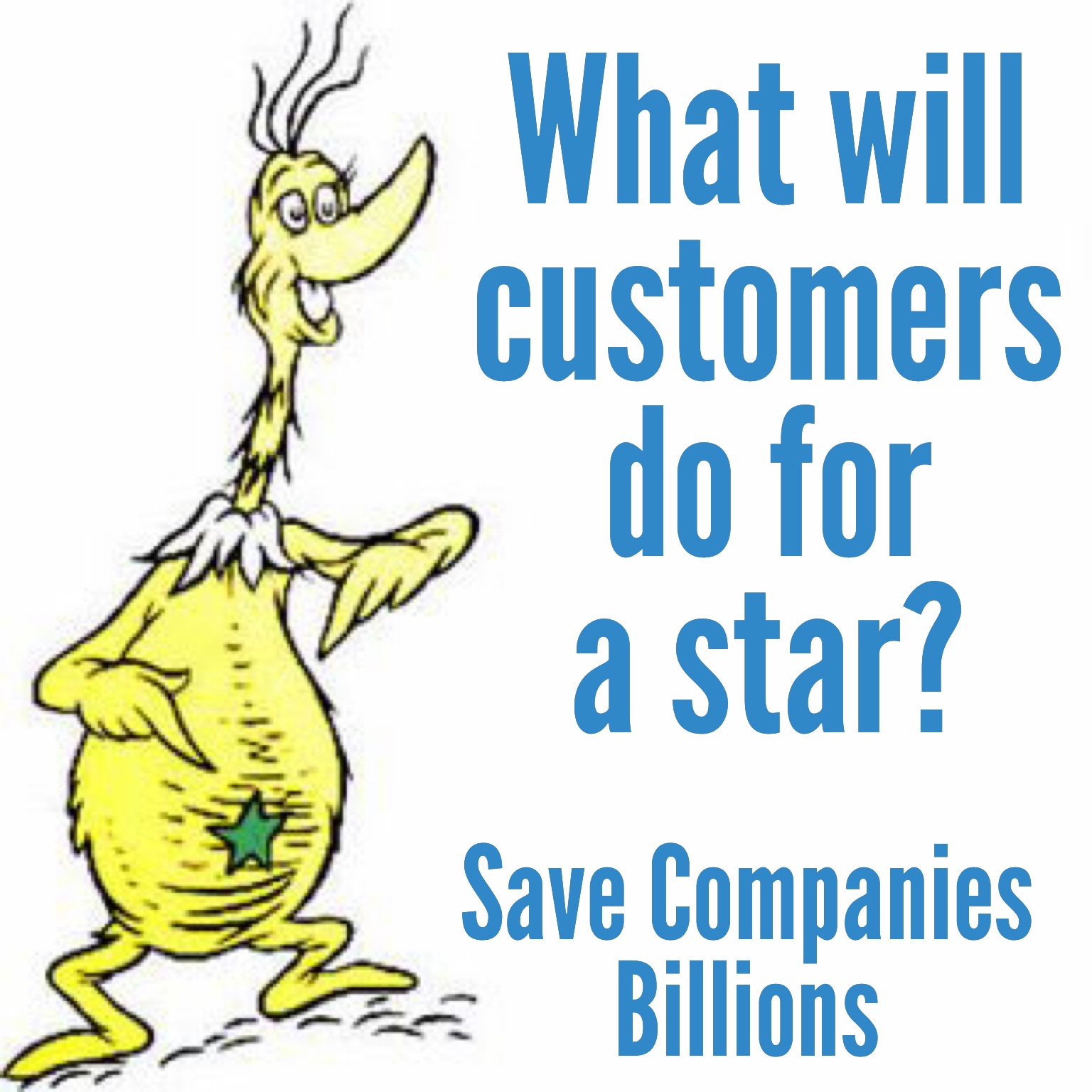
Li & Bernoff’s Groundswell tells us that the average call to a company’s call center costs $6-$7. Technical support calls are $10-$20. Way back in the early 2000’s TiVo noticed a consumer run TiVo Community Forum on the web. With no help from the company over 130,000 TiVo owners were solving each other’s problems. One user named “jsmeeker” had posted 44,000 times in 6 years.
Other company’s like Dell have started their own community support forums. Dell has been more intentional and is reaping the rewards. One user named “Predator” had posted 20,000 times answering tech support questions that were viewed over 2 million times. Considering the cost of call centers, this one customer saved Dell over a billion dollars in support costs. Dell wants to encourage more customers like this and has implemented a reward system so the most active members can earn their stars.
Dell Community Rockstars are nominated for their exceptional technical skills and willingness to help others. They also show leadership in the Dell community. What do they get? A star of course. The fancy star badge below. To be fair they also get some additional privileges and benefits including online and offline events and get to evaluate new products and services before others.

Dell community members give thousands of ideas and tech support for this star.
What else will someone do for a star? Help with new product development. Dell has also launched IdeaStorm to leverage the wisdom of the crowd to improve their products and services. IdeaStorm simply collects customer ideas in multiple categories from products to advertising and then the same customers vote on the ideas to help Dell identify the most promising. Since 2006, people have freely submitted over 20,000 ideas and nearly 550 have been implemented. What do they get in return? Points, votes and you guessed it, a star. Dell Rockstar badges also appear in IdeaStorm.
This is all well and good, but you may be saying to yourself, “Dell is a huge, well liked company. Of course, people want to contribute to them.” Don’t forget that Dell has not always been a well liked company. In fact, it used to be referred to as “Dell Hell” and is known for not listening to its customers as called out by Jeff Jarvis in his now famous “Dell sucks” blog post. The support forum and idea community are actually what helped Dell regain its customers.
 As customer support moves further away from the phone lines, it’s become easier for frustrated customers to express that frustration publicly on social networks like Twitter and Facebook. As a result, more and more brand customer support forums are popping up. In fact, Forrester research has found a 25% increase in customer service community usage in the past three years. For the brands that embrace this change, customer service can move from cost center to a differentiator.
What can you do? Fire Pole Marketing says launch a brand community and give them something to display. They say, “Provide them with a plaque, certificate or similar item. Simple things like online badges or a certificate work wonders.” I agree and I suggest you use a star.
Can customer support and idea communities be a star in your company?
 Adding To The Noise